Zombie Economics: How Dead Ideas Still Walk among Us by John Quigin
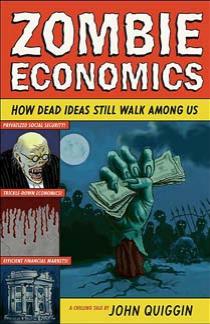
Author:John Quigin [Quigin, John]
Language: eng
Format: epub, pdf
Tags: Princeton University Press, 0691145822
Published: 2012-08-06T21:18:14+00:00
Of course, awareness of this fact will do nothing to moderate the po-
tential impact; if anything the reverse. People who are suddenly worried
about a recession will not, if they are looking to their own well- being,
keep spending in the hope that others will do likewise and thereby keep
the economy afloat. Rather they will reason that others are likely to think
as they do, and that a recession is even more probable than the objective
evidence would suggest.
Keynes’s idea of “animal spirits” has been revived by George Akerlof
and Robert Shiller in their recent book of the same name. Akerlof and
Shiller consider five deviations from the standard model of rational maxi-
mization (confidence/trust, fairness, corruption, money illusion, and sto-
ries) and argue that some combination of these can be used to explain a
range of economic outcomes inconsistent with the standard model. Their
discussion makes a compelling case that macroeconomics needs new, and
more realistic, foundations.
If the prospects for a macroeconomic analysis based on alternatives
to expected utility theory are so promising, why has so little work been
done along these lines? In part, perhaps, this simply reflects the effects of
128
CHAPTER 3
specialization. Decision theorists focus on individual choices, and when
they seek economic applications, this leads them naturally to look at mi-
croeconomic problems.
But there is a more fundamental problem. Individuals who satisfy the
conditions of expected utility theory display a property called “dynamic
consistency” which, as the name suggests, is of fundamental importance
in DSGE models. Dynamically consistent economic agents never change
their view of the world in any fundamental way. They respond to new
information by changing their subjective probabilities for particular
events, but they never change their underlying prior beliefs and prefer-
ences about the world. That means, in particular, that they can fully
anticipate how they will respond to any possible future situation and
would never wish to change their mind about this, or to “lock them-
selves in” to a course of action they might be unwilling to carry through
when the time comes.
Such consistency is admirable, at least in the eyes of decision theorists,
and makes it much easier to obtain well- defined solutions for DSGE mod-
els. Unfortunately, it is far from realistic. It turns out that the decisions
predicted by realistic models of choice under uncertainty always display
dynamic inconsistency under certain circumstances. This problem has
been the subject of considerable controversy on the rare occasions when
economists have sought to introduce more realistic risk preferences into
macroeconomic theory.
From the neoclassical viewpoint that dominates modern macroeconom-
ics, the absence of a coherent dynamic equilibrium concept seems like a
fatal objection. But from a Keynesian perspective, and on the basis of real
world experience, this is a positive, indeed necessary, feature of a sensible
macroeconomic model. The fundamental macroeconomic problem is pre-
cisely that an economy that seems to be enjoying an equilibrium path of
steady growth can suddenly crash, or veer off into an unsustainable boom.
Aggregate Models and Equilibrium
If there is one thing that distinguished Keynes’s economic analysis from
that of his predecessors, it was his rejection of the idea of a unique full
DYNAMIC STOCHASTIC GENERAL EQUILIbRIUM
129
employment equilibrium to which a market economy will automatically
return when it experiences a shock.
Download
Zombie Economics: How Dead Ideas Still Walk among Us by John Quigin.pdf
This site does not store any files on its server. We only index and link to content provided by other sites. Please contact the content providers to delete copyright contents if any and email us, we'll remove relevant links or contents immediately.
What's Done in Darkness by Kayla Perrin(26960)
The Ultimate Python Exercise Book: 700 Practical Exercises for Beginners with Quiz Questions by Copy(20859)
De Souza H. Master the Age of Artificial Intelligences. The Basic Guide...2024 by Unknown(20618)
D:\Jan\FTP\HOL\Work\Alien Breed - Tower Assault CD32 Alien Breed II - The Horror Continues Manual 1.jpg by PDFCreator(20538)
The Fifty Shades Trilogy & Grey by E L James(19463)
Shot Through the Heart: DI Grace Fisher 2 by Isabelle Grey(19381)
Shot Through the Heart by Mercy Celeste(19242)
Wolf & Parchment: New Theory Spice & Wolf, Vol. 10 by Isuna Hasekura and Jyuu Ayakura(17388)
Python GUI Applications using PyQt5 : The hands-on guide to build apps with Python by Verdugo Leire(17357)
Peren F. Statistics for Business and Economics...Essential Formulas 3ed 2025 by Unknown(17188)
Wolf & Parchment: New Theory Spice & Wolf, Vol. 03 by Isuna Hasekura and Jyuu Ayakura & Jyuu Ayakura(17100)
Wolf & Parchment: New Theory Spice & Wolf, Vol. 01 by Isuna Hasekura and Jyuu Ayakura & Jyuu Ayakura(16713)
The Subtle Art of Not Giving a F*ck by Mark Manson(14831)
The 3rd Cycle of the Betrayed Series Collection: Extremely Controversial Historical Thrillers (Betrayed Series Boxed set) by McCray Carolyn(14443)
Stepbrother Stories 2 - 21 Taboo Story Collection (Brother Sister Stepbrother Stepsister Taboo Pseudo Incest Family Virgin Creampie Pregnant Forced Pregnancy Breeding) by Roxi Harding(14221)
Cozy crochet hats: 7 Stylish and Beginner-Friendly Patterns from Baby Beanies to Trendy Bucket Hats by Vanilla Lazy(13505)
Scorched Earth by Nick Kyme(13099)
Reichel W. Numerical methods for Electrical Engineering, Meteorology,...2022 by Unknown(12980)
Drei Generationen auf dem Jakobsweg by Stein Pia(11259)
